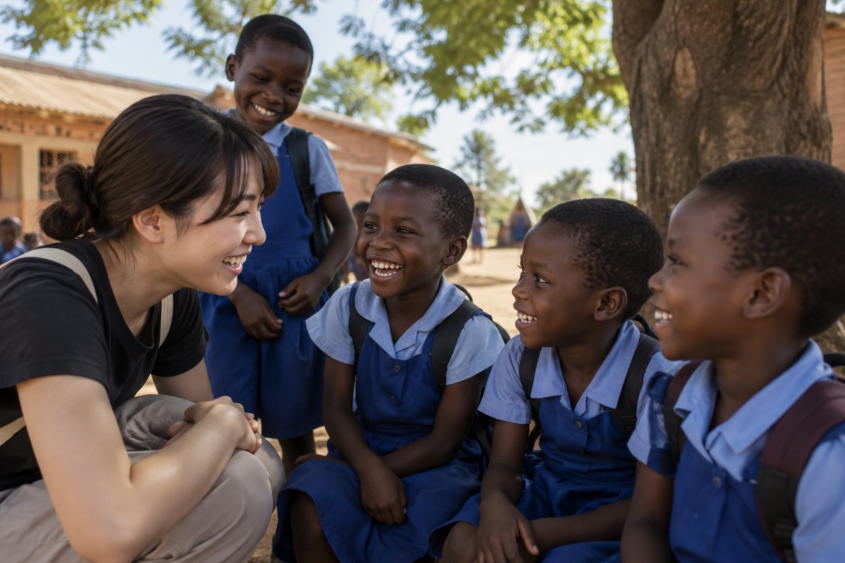
Almost everyone learning Japanese knows "Konnichiwa." But what if you wanted to greet someone in Malawi?
When people think about learning another language, English, Japanese, Spanish, and French often come to mind. However, there are thousands of languages spoken around the world, each offering a different way to understand culture and communication.
In Malawi, a country in southeastern Africa, one of the most widely spoken languages is Chichewa. Although English plays an important role in Malawi's education system, Chichewa is an essential part of everyday communication for many people.
So, how difficult would it be for someone in Japan to learn a little Chichewa? Let's find out.
You don't need to memorize hundreds of words to begin exploring a new language. Sometimes, five simple phrases are enough to start a conversation.
| Chichewa | English |
|---|---|
| Moni | Hello |
| Muli bwanji? | How are you? |
| Ndili bwino | I am fine |
| Zikomo | Thank you |
| Dzina langa ndi... | My name is... |
Now imagine meeting someone from Malawi for the first time. Instead of beginning with an English greeting, you say: "Moni! Muli bwanji?"
Even if the rest of your conversation takes place in English, making the effort to greet someone in their language can be a thoughtful way to show interest in their culture.
Of course, Chichewa is only one of the languages spoken in Malawi. Other languages, including Chitumbuka and Yao, are also important in different communities.
Japanese and Chichewa belong to entirely different language families, but learning either language introduces students to unfamiliar ways of communicating. For Japanese speakers, Chichewa presents new vocabulary, pronunciation patterns, and grammatical structures.
For example, Japanese learners might recognize the importance of choosing polite expressions depending on who they are speaking to. Chichewa also has ways of expressing respect through language. The word "inu," meaning "you," can be used politely when addressing one person, as well as when addressing multiple people.
Although the two languages function differently, both demonstrate how communication involves more than simply translating words.
Language learning is about more than passing exams. It allows us to participate in conversations, appreciate cultural differences, and build relationships with people from different backgrounds. This is especially important when learning about countries we may never have visited.
Malawi is often introduced to international audiences through discussions of poverty, development, and humanitarian aid. However, understanding Malawi also means recognizing its languages, traditions, communities, and everyday experiences. Learning even a few Chichewa phrases can be a starting point for discovering a country beyond the headlines.
Beehive Talk is run by Seibo Japan, an NPO that works with its Malawian partner organization, Seibo Maria, to support school feeding programs that help children participate in education. But connecting these two countries also creates opportunities for cultural exchange.
For students in Japan, learning about Malawi can encourage curiosity about different languages and ways of life. For learners around the world, the experience is a reminder that education extends far beyond the classroom.
So, the next time you learn a new English or Japanese word, consider adding one more language to your vocabulary.
Start with "Moni." You might be surprised by the conversations that follow.
Want to go further? Learn Chichewa with a teacher from Malawi in a live online lesson on Beehive Talk, where every lesson helps provide school meals for children there. Find a Chichewa teacher →
Please rotate your device for better view