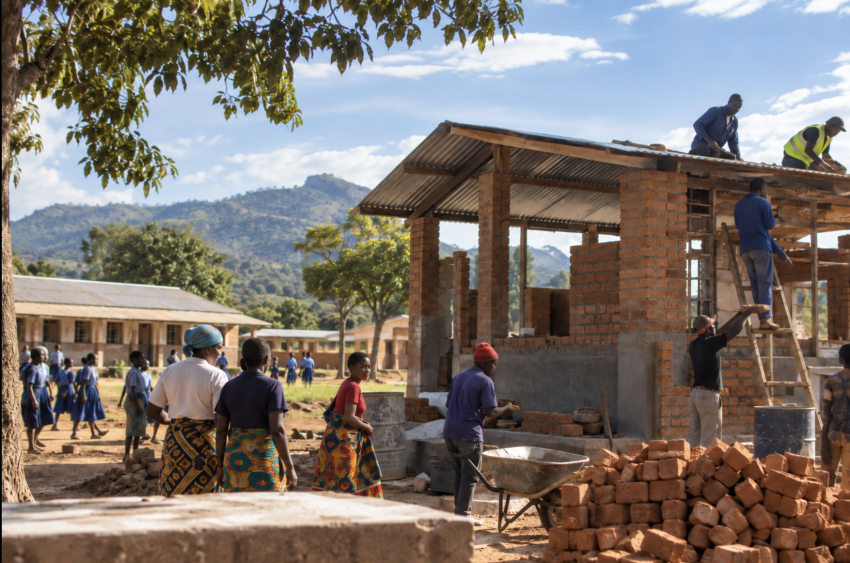
What could a kitchen in Malawi possibly have to do with Japan? More than you might expect.
When we think about improving education, we usually imagine building classrooms, providing textbooks, or hiring more teachers. But what about building a kitchen?
In Malawi, an important part of supporting children's education begins before the first lesson of the day. For students who experience food insecurity, having access to a meal at school can make a meaningful difference. And in 2026, Japan took another step toward supporting this effort.
In February 2026, the Japanese government and Seibo Maria, the Malawian partner organization of Seibo Japan (the NPO behind Beehive Talk), signed a grant agreement supporting the construction of three school feeding kitchens in Malawi's Mzimba District. The agreement was signed by Japan's Ambassador to Malawi, Ambassador Naito, and Seibo Maria's Program Manager, Victor Mthulo.
The goal is to improve the conditions in which school meals are prepared and distributed. By creating more hygienic and reliable cooking facilities, the project aims to strengthen the school feeding programs serving children in northern Malawi.
But why are school kitchens so important?
In Japan, students are familiar with the idea of kyushoku, the school lunch system. Meals are carefully planned, prepared, and distributed through organized systems designed to support children's nutrition.
However, running a school feeding program requires more than simply purchasing food. Someone must organize ingredients, store supplies, prepare meals, maintain equipment, and ensure that food is handled safely. In Malawi, local staff members, caregivers, and volunteers play important roles in this process.
A properly equipped kitchen can help make these responsibilities easier to manage and support the consistent preparation of meals. For schools serving large numbers of children, improvements to these facilities can have an impact beyond the kitchen itself.
Imagine trying to study a foreign language while feeling hungry. You are expected to remember new vocabulary, listen carefully, and answer questions. Now imagine doing that every day without knowing whether you will have enough to eat.
Hunger can interfere with concentration and classroom participation. School feeding programs help address this challenge by providing meals that support children's nutritional needs and encourage regular attendance. In Malawi, where many communities face economic and food-security challenges, reliable school meals can be an important part of helping children stay engaged in education.
This is why investing in school kitchens is also an investment in the learning environment.
The partnership between Japan and Malawi demonstrates that international cooperation can take many different forms. Sometimes, countries exchange technology or develop business partnerships. Other times, cooperation involves something as practical as improving school kitchens.
Local knowledge and involvement remain essential to making these initiatives work. By combining support from Japan with the experience of Malawian communities, these projects aim to create lasting improvements in children's daily lives.
Three school kitchens may sound like a small project compared with the scale of global educational challenges. However, the facilities represent something larger: an effort to make school feeding more reliable, sustainable, and accessible. For children who depend on meals provided at school, these improvements matter.
And for supporters in Japan, the project offers a reminder that meaningful international cooperation does not always require complicated solutions. Sometimes, supporting education begins with creating a better place to prepare breakfast.
Because a stronger education system needs more than classrooms. It also needs the everyday resources that help children arrive ready to learn.
Every Beehive Talk lesson helps provide school meals for children in Malawi. Find a teacher and book your first lesson →
Please rotate your device for better view